Storm Windows
Storm Windows vs Replacement Windows, Cost and Performance Data for 2026
Replacement benchmarks and dated storm-window studies answer different questions. Compare costs, resale estimates, energy savings and the work your home needs.
For a defined 10-window replacement project, JLC's 2025 Cost vs Value Report lists national job costs of $22,073 for vinyl and $26,781 for wood. Those figures describe specified replacement jobs, rather than prices for adding storm windows to an existing opening.
The useful comparison of storm windows vs replacement windows starts with the work your home needs. A supplemental panel retains the primary window. Replacement changes the window unit. Compare the condition of the existing assembly, the proposed work and the financial measure before deciding which number belongs in your budget. The evidence below separates project benchmarks, a small installation pilot, resale estimates and energy savings.
Key Comparison Statistics at a Glance
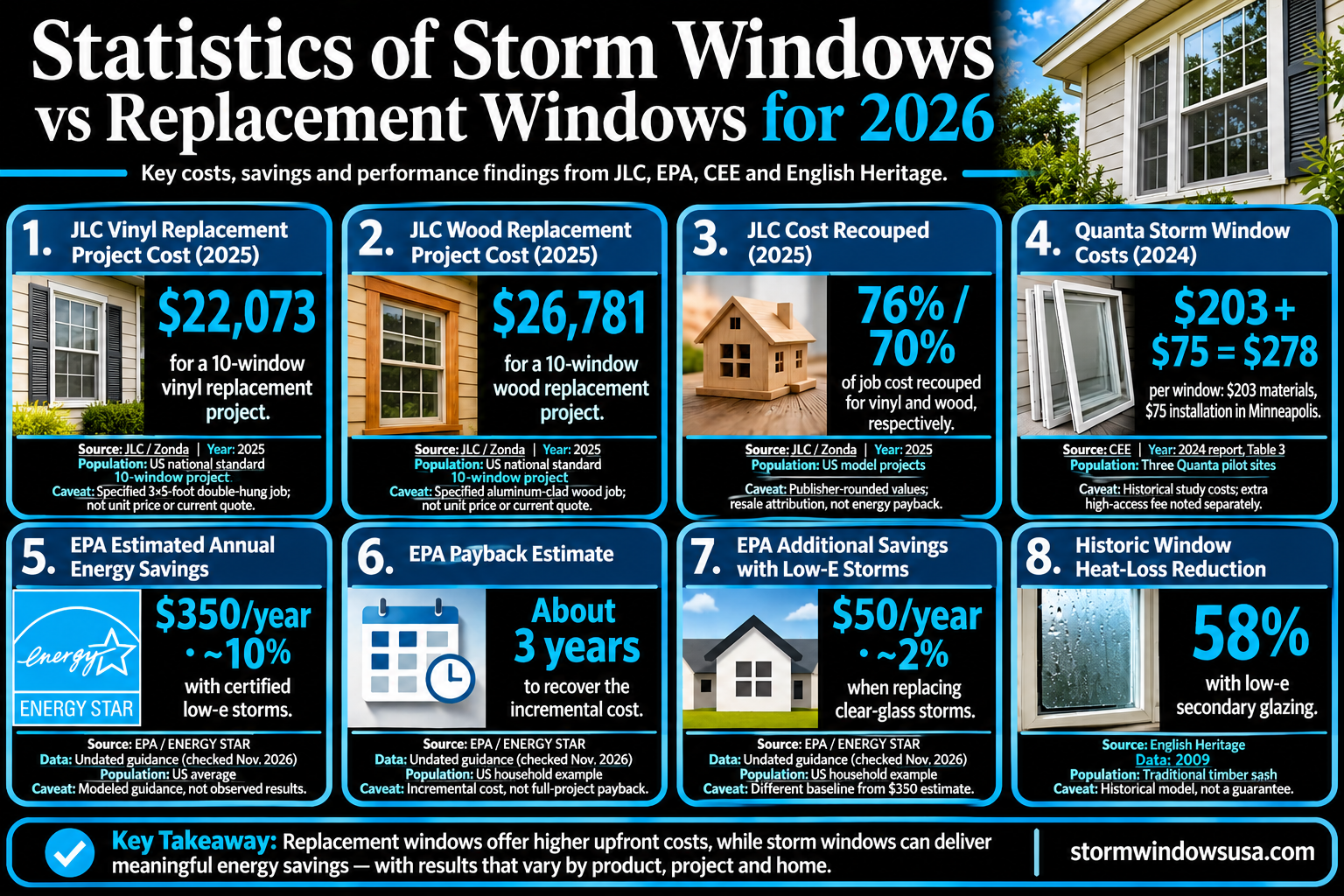
- JLC's 2025 national report gives a $22,073 job-cost benchmark for its specified 10-window vinyl replacement project.
- JLC's 2025 national report gives a $26,781 job-cost benchmark for its specified 10-window wood replacement project.
- JLC's 2025 report displays rounded cost-recouped figures of 76% for vinyl and 70% for wood replacement, based on estimated resale value.
- The Center for Energy and Environment's October 2024 Minneapolis pilot report lists average Quanta materials of $203 per window, $75 for measurement and installation, and $278 combined in its study table.
- EPA's ENERGY STAR guidance available in 2026 estimates $350 a year, about 10% of heating and cooling bills, for certified low-e storms over single-pane clear glass with no existing storms.
- EPA's ENERGY STAR guidance available in 2026 describes about three years to recover the incremental cost of certified storm windows. That is not a universal full-project payback.
- EPA's ENERGY STAR guidance available in 2026 estimates an additional $50 a year, about 2%, when certified low-e storms replace clear-glass storms over single-pane windows.
- English Heritage's 2009 timber-window report estimated a 58% reduction in whole-window heat loss with low-e secondary glazing for one traditional timber sash test assembly.
How much did the replacement projects in the 2025 report cost?
$22,073 for vinyl and $26,781 for wood were the national job-cost benchmarks in JLC's 2025 report. These are project benchmarks, not a price schedule for every replacement window.
The vinyl job specification published by JLC in June 2025 replaces 10 three-by-five-foot double-hung windows with insulated low-e units, simulated divided lights and a custom-color exterior. The wood specification from the same edition uses the same count and opening size, with stained hardwood inside and custom-color aluminum cladding outside. Both call for matching exterior trim and retaining existing interior trim.
Before comparing a quote with either benchmark, ask how its scope differs. A different opening size, finish, glazing package or trim treatment changes the work being priced. A proposal that includes repairs around the opening needs a separate line for them.
Use a written schedule for your own openings. Identify what stays, what comes out, what is installed and what the contractor must make good afterward. That schedule makes competing proposals easier to compare without treating a national model job as a local quotation.
How much replacement cost did the report assign to resale value?
76% for vinyl and 70% for wood are the rounded cost-recouped figures displayed in JLC's 2025 national table. Its estimated resale values are $16,657 and $18,764, respectively.
JLC's September 2025 methodology describes indexed project costs and local remodeling-estimate data. Its resale values come from surveyed Realtors' judgments about a defined project. They are not measured sale-price gains for every completed home.
Resale recovery and utility-bill payback answer different questions. Resale is about the value attributed to an improvement when a home is sold. Energy payback compares an upfront cost with annual operating savings. A resale percentage does not tell you how many years an energy retrofit takes to recover its cost.
Keep those measures in separate columns when weighing options. Record the installed quote, the reason for the work and the financial outcome being estimated. Do not add a national resale estimate to projected energy savings and present the sum as a guaranteed return.
A homeowner planning repairs for comfort or operation can have a sound reason to proceed without a short energy payback. The decision should name that benefit rather than promise that a utility bill will repay every part of the project.
What did the Minneapolis pilot record for storm-window costs?
$203 in average materials and $75 in measurement and installation produced the $278 Quanta average shown in the Center for Energy and Environment's 2024 pilot table. This is historical study pricing for the assessed product and sites, not a 2026 national average or a Storm Windows USA quote.
The same October 2024 report says the contractor's installation charge included removing the old storm, installing the new product and disposing of the old unit. One site incurred an added flat fee for higher second-story windows. Other products in the table were installed by homeowners, so their listed material prices do not include a comparable paid-labor allowance.
That distinction matters when reading any inexpensive per-window figure. A unit price can leave measurement, access, removal or finishing work outside the number. A homeowner-installed product and a contractor-installed product have different cost boundaries.
For a current project, request a quote that separates the panel from the work around it. Use the measuring guide to identify the correct measurements for the selected window type before pricing a made-to-size unit.
How much annual savings does EPA estimate for the no-storm baseline?
$350 a year, about 10% of heating and cooling bills, is the national-average estimate in EPA's ENERGY STAR guidance available in 2026. It applies to certified low-e storm windows installed over single-pane clear glass without existing storm windows.
The starting window belongs beside the savings figure. It is not an estimate for every home, for every replacement window or for an ordinary clear-glass storm. The same EPA guidance identifies climate, home characteristics and utility rates as factors that change the result. Its estimate excludes savings from reducing air leakage.
To compare options for a particular home, identify the existing glazing and any storm already in place. Then ask what assumptions support the proposed energy result. A quote without that baseline cannot show whether a published saving is relevant to the opening.
Our storm-window energy savings guide covers the performance evidence in more detail. This comparison uses those findings to separate expected operating savings from replacement scope and price.
Does EPA's three-year estimate repay the entire installed project?
About three years is the incremental-cost payback described in EPA's ENERGY STAR guidance available in 2026. The word incremental must stay attached to that figure.
A full-project calculation uses the cost of the complete proposed installation. An incremental calculation uses the extra cost of one option over its comparison option. Those are different numerators. Replacing one with the other can make a payback claim appear much shorter than the project being considered.
Ask for the comparison option, the extra cost and the annual saving used in a payback estimate. Check that the cost and saving describe the same change. Include any recurring cost assumed in the analysis and state what the calculation leaves out.
A simple payback estimate is a planning aid. It does not replace an assessment of operating condition, appearance, future maintenance or the value of retaining an original window. Keep those reasons visible rather than forcing them into a single promised return.
What changes when clear-glass storm windows are already installed?
An additional $50 a year, about 2% of heating and cooling bills, is EPA's current estimate for replacing clear-glass storms with certified low-e storms over single-pane windows, as reviewed in 2026.
That baseline differs from adding certified storms where none existed. Use the estimate that matches the starting assembly. Applying the larger no-storm saving to a home that already has storms would misstate the comparison.
Record the existing storm's condition and glazing when requesting a quote. Then separate any needed repair from the proposed performance upgrade. The energy-efficient storm window guide explains the roles of glazing, seals and fit without assigning one saving to every assembly.
What did the traditional-window research find about keeping the original sash?
58% was the estimated reduction in whole-window heat loss with low-e secondary glazing in English Heritage's 2009 timber-window study. The work tested one traditional timber sash assembly in the United Kingdom, then modeled the frame contribution to whole-window performance.
The 2009 report separates a measured glazing-only heat-loss reduction of 63% from the estimated whole-window result. Neither percentage describes a household energy bill or establishes the performance of a current American product.
The study supports evaluating an upgrade before assuming that an older window must be removed. It does not resolve the condition of a particular sash or opening. Ask what repair is needed, what the added system requires and which parts of the original window will remain.
For an older property, review the historic-home storm window options alongside the condition assessment. Keeping a window and improving it should be evaluated as a defined scope of work.
Build a comparison around your actual openings
Start with the problem you need to solve. Drafts, difficult operation, damaged joinery and a failed surrounding assembly can require different work. Have the existing condition assessed before choosing a product around a published price.
Ask each proposal to identify the primary window, the supplemental or replacement unit, glazing, operating clearance, access, removal, disposal and finishing. Check what is excluded and who is responsible for resolving an unexpected condition.
A useful comparison keeps current quotations together and historical research in a separate evidence column. It names the energy baseline and distinguishes an estimated resale outcome from operating savings. That gives you a record you can revisit when the scope or price changes.
Compare options for your window
Storm Windows USA offers custom-sized storm windows for existing openings. Compare the selected product's specifications and a current project quote with the work required for replacement before deciding which approach fits your home.